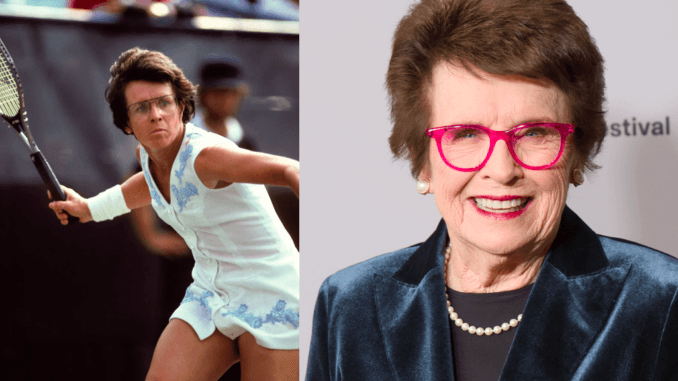
Billie Jean King biography: the tennis legend and activist who at 82 continues shaping women’s sports, from an Oxford honorary degree to a Harvard civic award in 2026.
Highlights at a Glance
- Won 39 Grand Slam titles across singles, doubles, and mixed doubles, including a record 20 Wimbledon titles
- Defeated Bobby Riggs in the 1973 “Battle of the Sexes,” one of the most watched tennis matches in history
- Married wife Ilana Kloss in 2018 and remains one of sport’s most prominent advocates for gender and pay equity
Who Is Billie Jean King?
Billie Jean King is an American former tennis player, widely regarded as one of the greatest athletes of the twentieth century and among the most consequential figures in the history of sport. She did not merely win matches. She changed the rules of the game, literally and structurally, for every woman who came after her.
Born in Long Beach, California, King became a professional force in the 1960s and remained dominant through the late 1970s. But it is what she did off the court, founding the Women’s Tennis Association, fighting for equal prize money, and confronting the sporting establishment in a televised match watched by nearly 90 million people, that defines her place in history.
At 82 years old in 2026, she is still going. In April, she accepted the Gleitsman Citizen Activist Award at the Harvard Kennedy School. Weeks earlier, the University of Oxford awarded her an honorary degree at their annual Encaenia ceremony. The story is not winding down.
Get to Know Billie Jean King
| Detail | Information |
|---|---|
| Full Name | Billie Jean King (née Moffitt) |
| Date of Birth | 22 November 1943 |
| Age | 82 (as of 2026) |
| Birthplace | Long Beach, California, USA |
| Nationality | American |
| Profession | Former tennis player, activist, entrepreneur |
| Grand Slam Titles | 39 (12 singles, 16 doubles, 11 mixed doubles) |
| Wife | Ilana Kloss (married 18 October 2018) |
| Net Worth | Estimated $20 million |
| Notable Honours | Presidential Medal of Freedom, Oxford honorary degree (2026), Hollywood Walk of Fame (2025) |
Early Life and Background
Billie Jean Moffitt was born on 22 November 1943 to Bill Moffitt, a firefighter, and Betty Moffitt. She grew up in Long Beach, California, alongside her brother Randy Moffitt, who would later pitch twelve seasons in Major League Baseball for the San Francisco Giants.
Sport was the natural language of the household, but the sport Billie Jean first pursued was softball. She switched to tennis at eleven years old and was immediately consumed by it. What struck her early was the inequality built into the sport itself. Everyone wore white, everyone who played was white, and the prize structures were weighted heavily against women.
“I thought, if I could become number one, I could help change the world,” she later said.
She would do exactly that.
Education
King attended Long Beach Polytechnic High School, graduating in 1961. She then enrolled at Los Angeles State College, now California State University, Los Angeles (Cal State LA), where she met a student named Larry King in the library in 1963.
She left Cal State in 1964 before completing her degree, choosing to focus on a professional tennis career. In 2025, she returned to the institution with the intent of finally finishing her degree, more than six decades later.
In 2026, the University of Oxford awarded her an honorary degree at their annual Encaenia ceremony, recognising a lifetime of achievement that no academic transcript could have anticipated.
Career Journey
The Rise to World Number One
King turned professional in the late 1960s and rapidly established herself as the dominant force in women’s tennis. In 1968, she won Wimbledon in the first year the tournament offered prize money, earning roughly 37.5 percent of what the men’s champion received. She noted the disparity immediately, and never forgot it.
Her singles game was built on aggression. An attacking net-rusher with exceptional speed and a powerful volley, she played a style that demanded respect. Chris Evert once noted her weakness was impatience, a fair observation and also, in another sense, entirely true of her wider life.
By 1972, King had won the French Open, completing a career Grand Slam in singles, becoming only the fifth woman in tennis history to hold all four major singles titles simultaneously. She also completed a career Grand Slam in mixed doubles.
Her record at Wimbledon remains one of the most remarkable in the sport’s history. She won twenty titles across singles, doubles, and mixed doubles on the grass of the All England Club, six in singles alone.
The Battle of the Sexes
No single event captures Billie Jean King’s legacy more dramatically than the match played on 20 September 1973 at the Houston Astrodome.
Bobby Riggs, a 55-year-old former Wimbledon champion and committed self-promoter, had claimed publicly that women’s tennis was so inferior that he could beat any top female player even at his age. King, then 29 and the world’s number one, accepted his challenge.
The match drew an estimated 90 million television viewers worldwide. King defeated Riggs in straight sets, 6-4, 6-3, 6-3. It was not close. The cultural impact, however, was seismic. The match arrived at a pivotal moment for the women’s movement and gave millions of people a televised symbol of what female athletic excellence actually looked like.
Building the Women’s Game
King’s activism ran alongside her playing career, not after it. In 1970, she and eight other players, later known as the Original Nine, signed symbolic $1 contracts with publisher Gladys Heldman in Houston to protest prize disparities at the Pacific Southwest Open, where the men’s champion earned $12,500 compared to $1,500 for the women’s champion. That act of defiance was the birth of women’s professional tennis as an independent structure.
Three years later, just four days before Wimbledon in 1973, King helped organise top players into what became the Women’s Tennis Association. She had been pushing for the idea for years. The WTA formalised a governing structure for women’s professional tennis and gave players collective bargaining power for the first time.
Post-Playing Career and Business
King retired from professional singles competition in 1983. She did not slow down.
She co-founded World Team Tennis in 1973, a league built around gender equality in team composition, prize money, and billing. She founded the Women’s Sports Foundation, which has distributed millions of dollars in grants to women athletes. She became a minority owner of the Los Angeles Dodgers in September 2018, the Los Angeles Sparks in the WNBA, and Angel City FC in the NWSL from 2020. In 2023, she partnered in efforts that led to the creation of the Professional Women’s Hockey League (PWHL).
In 2025, she became the first woman to receive a star on the Hollywood Walk of Fame in the category of sports entertainment.
Career Timeline and Major Milestones
| Year | Milestone |
|---|---|
| 1943 | Born in Long Beach, California |
| 1961 | Graduated Long Beach Polytechnic High School |
| 1966 | Won first Wimbledon singles title |
| 1968 | Won Wimbledon in tournament’s first year offering prize money |
| 1972 | Completed career Grand Slam in singles with French Open title |
| 1973 | Co-founded World Team Tennis; helped form the WTA; won the Battle of the Sexes |
| 1974 | Founded Women’s Sports Foundation |
| 1983 | Retired from professional singles tennis |
| 2006 | US Open venue renamed the Billie Jean King National Tennis Center |
| 2009 | Awarded Presidential Medal of Freedom |
| 2018 | Married Ilana Kloss; became minority owner of the LA Dodgers |
| 2020 | Joined ownership group of Angel City FC |
| 2025 | First woman to receive Hollywood Walk of Fame star in sports entertainment |
| 2025 | Returned to Cal State LA to complete her degree |
| 2026 | Honorary degree from the University of Oxford; Gleitsman Award from Harvard |
Key Takeaways
- King’s 39 Grand Slam titles span four decades of professional competition
- Her off-court campaigns, the Original Nine, the WTA’s founding, the Battle of the Sexes, reshaped women’s professional sport permanently
- She and Ilana Kloss hold minority stakes in three major sports franchises across MLB, WNBA, and NWSL
- At 82, King continues to receive major civic and academic honours while remaining an active voice on women’s sports policy
What Is Billie Jean King’s Net Worth?
Billie Jean King’s net worth is widely estimated at approximately $20 million, drawn from a career spanning professional tennis prize money, decades of endorsements, co-ownership of sports leagues, and her minority stakes in the LA Dodgers, LA Sparks, and Angel City FC. Some outlets have cited figures as high as $40 million when factoring in the appreciated value of sports franchise investments, though that figure is unverified. Together with her wife Ilana Kloss, their combined net worth has been estimated at over $25 million.
Personal Life
Marriage to Larry King
King met Larry King at Cal State LA in 1963 and the pair married on 17 September 1965 in Long Beach. Larry was instrumental in encouraging Billie Jean’s professional tennis ambitions and later co-founded World Team Tennis alongside her. The marriage lasted over two decades. In 1972, Larry revealed in a Ms. magazine article, without Billie Jean’s knowledge, that she had had an abortion the previous year. King addressed the decision directly in a 2018 interview, saying she was “not in a good place” and was “just finding out about my sexuality” at the time.
In 1981, a palimony lawsuit filed by Marilyn Barnett, with whom King had had a relationship, made her sexuality public. King lost approximately $2 million in endorsements as a result. She and Larry divorced in 1987.
Who Is Billie Jean King’s Wife?
Billie Jean King has been with Ilana Kloss since their relationship developed after years as doubles partners on the professional circuit. Kloss, born in Johannesburg, South Africa, is herself a former professional tennis player and became a prominent sports executive following her playing career.
The couple married on 18 October 2018 in a ceremony performed by former New York City Mayor David Dinkins. They have built an extensive shared portfolio of sports investments alongside one another, including their minority stakes in the LA Dodgers, LA Sparks, and Angel City FC. Kloss also serves on the advisory board of the PWHL, and the league’s playoff MVP award bears her name.
Awards and Recognitions
King’s list of honours is extensive. She received the Presidential Medal of Freedom in 2009. The US Open venue in New York was renamed the Billie Jean King National Tennis Center in 2006. She has been inducted into the International Tennis Hall of Fame and received honorary degrees from numerous institutions, including the University of Oxford in 2026. In 2025, she became the first woman honoured on the Hollywood Walk of Fame in the sports entertainment category.
At Harvard in April 2026, accepting the Gleitsman Citizen Activist Award, she closed her remarks by quoting Coretta Scott King: “Struggle is a never-ending process. Freedom is never really won. You earn it and win it in every generation.” Then she turned to the students in the room and said simply, “It’s your turn. Make it work.”
Legacy and Influence
Billie Jean King did not ask for permission to change tennis. She changed it, and then changed the institutions around it. The WTA exists because she and eight other women risked their careers to demand something better. Equal prize money at Grand Slams, now standard, was unthinkable until she made it thinkable.
Her influence runs through the WNBA, the NWSL, the PWHL, and every women’s sports league that operates today on the assumption that women’s sport deserves serious investment and serious audiences. She did not build that assumption from nothing. She built the argument for it, match by match, lawsuit by lawsuit, press conference by press conference, across six decades.
Conclusion
At 82, Billie Jean King is collecting honorary degrees from Oxford, delivering keynotes at Harvard, and pushing the WTA to reckon with its partnership with Saudi Arabia’s sovereign wealth fund because she does not do quiet retirement. The standard she has set — that sports must reflect the equality they claim to celebrate — remains largely unmet. She knows it, and she keeps saying so.
The question her life leaves for every generation that follows is not whether the fight for equity was worth having. It is whether they will finish it.
Leave a Reply