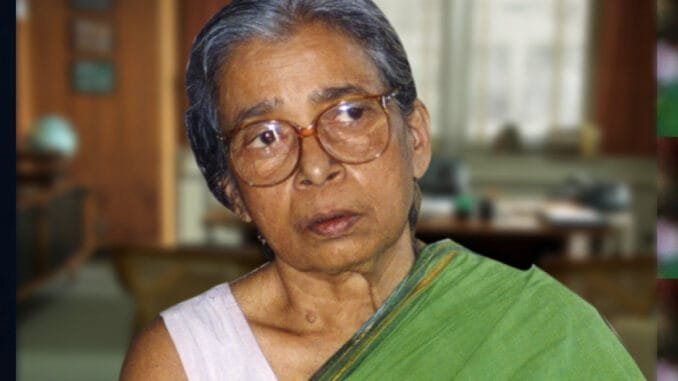
Mahasweta Devi biography covers the Bengali writer and activist’s life, her books like Hajar Churashir Maa, awards, and work for tribal rights.
Who is Mahasweta Devi?
Mahasweta Devi biography chronicles the extraordinary life of one of India’s most celebrated writers and social activists. Born on 14 January 1926 in Dhaka, British India (now Bangladesh), she dedicated her life to giving voice to the voiceless through powerful literary works and relentless activism. She passed away on 28 July 2016 in Kolkata at the age of 90.
Devi’s literary career spanned over six decades, during which she authored more than 100 novels and 20 collections of short stories. Her works focused on tribal communities, Dalits, and other marginalised sections of Indian society. She believed her stories were not her own creation but the authentic narratives of the people she lived among.
Beyond literary achievements, Mahasweta Devi championed the rights of indigenous communities across West Bengal, Bihar, Madhya Pradesh, and Chhattisgarh. She lived in Adivasi villages for extended periods, documenting their struggles against systemic oppression.
Her contributions earned India’s highest honours, including the Jnanpith Award, Ramon Magsaysay Award, and Padma Vibhushan. Google honoured her with a Doodle on her 92nd birth anniversary in 2018.
Quick Facts Table
| Attribute | Details |
|---|---|
| Full Name | Mahasweta Devi |
| Date of Birth | 14 January 1926 |
| Place of Birth | Dhaka, British India (now Bangladesh) |
| Date of Death | 28 July 2016 |
| Age at Death | 90 years |
| Nationality | Indian |
| Profession | Writer, Activist, Journalist, Teacher |
| Father | Manish Ghatak (poet, novelist) |
| Mother | Dharitri Devi (writer, social worker) |
| First Husband | Bijon Bhattacharya (1947-1962) |
| Second Husband | Asit Gupta (1962-1976) |
| Son | Nabarun Bhattacharya (1948-2014) |
| Education | MA English, Calcutta University |
| Notable Works | Hajar Churashir Maa, Rudali, Aranyer Adhikar |
| Major Awards | Jnanpith, Padma Vibhushan, Ramon Magsaysay |
Early Life and Background
Mahasweta Devi was born into a distinguished Bengali Brahmin family with deep literary roots. Her father, Manish Ghatak, was a renowned poet and novelist of the Kallol movement who wrote under the pseudonym Jubanashwa. Her mother, Dharitri Devi, was a writer and social worker who promoted literacy among underprivileged children.
The family’s artistic legacy extended through her uncle, the visionary filmmaker Ritwik Ghatak. Growing up in such an intellectually stimulating environment, young Mahasweta developed an early appreciation for literature and social consciousness.
Her childhood was marked by significant historical events including the Quit India Movement of 1942, the devastating Bengal Famine of 1943, the Great Calcutta Riots of 1946, and the traumatic Partition of India in 1947. These formative experiences profoundly shaped her worldview and later found expression in her literary works.
Educational Background
Mahasweta Devi began her education at Eden Montessori School in Dhaka. Following the partition of Bengal, her family relocated to West Bengal. She attended Shantiniketan, the renowned school founded by Nobel laureate Rabindranath Tagore.
She completed her Bachelor of Arts degree with honours in English from Vishva-Bharati University in Shantiniketan. Subsequently, she pursued her Master of Arts degree in English Literature from Calcutta University.
Her education provided the intellectual foundation to engage critically with colonial history and social structures. This academic grounding proved invaluable when she began her writing career, enabling her to craft narratives that were both artistically sophisticated and socially relevant.
Career Journey
Mahasweta Devi’s professional life encompassed multiple roles as writer, teacher, and journalist. After completing her education, she worked briefly at a post office but was dismissed due to her communist leanings. She subsequently took on various jobs, including selling soaps and writing letters for illiterate people.
In 1964, she joined Vijaygarh Jyotish Ray College as an English lecturer, teaching working-class women students until 1984. Throughout her teaching years, she simultaneously worked as a journalist and contributed to literary magazines.
Her first novel, Jhansir Rani (The Queen of Jhansi), was published in 1956. This biographical work about Rani Lakshmi Bai required extensive research, with Devi travelling to collect information and folk songs from local communities.
The Naxalite movement of the late 1960s became a turning point in her career. She felt obligated to document this period, resulting in Hajar Churashir Maa (Mother of 1084), exploring a mother’s political awakening after her son is killed for his Naxalite beliefs.
Career Timeline
| Year | Milestone | Significance |
|---|---|---|
| 1956 | Published Jhansir Rani | Debut novel on Rani of Jhansi |
| 1964 | Joined Vijaygarh Jyotish Ray College | Began teaching career |
| 1974 | Published Hajar Churashir Maa | Landmark novel on Naxalite movement |
| 1977 | Published Aranyer Adhikar | Won Sahitya Akademi Award |
| 1984 | Retired from teaching | Dedicated fully to writing and activism |
| 1996 | Received Jnanpith Award | India’s highest literary honour |
| 1997 | Received Ramon Magsaysay Award | International recognition |
Personal Life and Relationships
On 27 February 1947, Mahasweta Devi married Bijon Bhattacharya, a renowned playwright and founding member of the Indian People’s Theatre Association. In 1948, they welcomed their only child, Nabarun Bhattacharya, who became an acclaimed novelist and political critic.
The marriage faced difficulties due to financial struggles and ideological differences. The couple divorced in 1962, with Bijon raising their son. That same year, Mahasweta married author Asit Gupta, though this relationship ended in 1976.
Despite personal challenges, Devi maintained close ties with her son Nabarun until his death from cancer in 2014. Her personal losses deepened her commitment to her work.
Literary Works and Writing Style
Mahasweta Devi’s literary output was prolific. She authored over 100 novels, more than 20 collections of short stories, plays, and extensive journalistic writings. Her works were primarily written in Bengali but have been translated into numerous languages.
Her writing focused on Adivasi, Dalit, and marginalised communities, particularly their women. Notable works include Rudali, depicting professional mourners from oppressed castes, and Draupadi, a powerful reimagining of the Mahabharata character as a tribal woman fighting oppression.
Postcolonial scholar Gayatri Chakravorty Spivak translated several of Devi’s works into English, including Imaginary Maps and Breast Stories. These translations brought her narratives to international audiences.
Social Activism
Mahasweta Devi’s activism was inseparable from her writing. She lived among tribal communities for years, understanding their struggles firsthand. Her 1977 novel Aranyer Adhikar chronicled Birsa Munda’s life, and her activism led to the removal of colonial-era shackles from Munda’s commemorative statue in 2016.
She founded and contributed to Bortika, a Bengali quarterly dedicated to documenting oppressed communities. Her 1998 lecture on Denotified Tribes led to the establishment of the Denotified and Nomadic Tribes’ Rights Action Group.
Devi played a significant role in the Nandigram movement, opposing forcible land acquisition from farmers. She supported Mamata Banerjee in the 2011 West Bengal elections, contributing to the end of 34 years of Left Front rule.
Major Achievements
Mahasweta Devi received numerous prestigious awards. The Sahitya Akademi Award in 1979 recognised her novel Aranyer Adhikar. The Padma Shri in 1986 honoured her social work with tribal communities.
The Jnanpith Award in 1996, India’s highest literary honour, was presented by Nelson Mandela. The following year, she received the Ramon Magsaysay Award for her compassionate crusade for tribal peoples. The Padma Vibhushan in 2006 recognised her exceptional contributions.
She was shortlisted for the Man Booker International Prize in 2009 and nominated for the Nobel Prize in Literature in 2012. Her biopic Mahananda was released in 2022.
Final Thoughts
Mahasweta Devi’s legacy extends far beyond her literary achievements. She demonstrated that the pen could be a weapon for social justice, amplifying the voices of those whom society had silenced. Her belief that creative writers must have a social conscience continues to inspire generations.
Her dedication to living among the communities she wrote about distinguished her from armchair intellectuals. She donated her award money to tribal communities and remained committed until her final days. When asked about her remaining years, she famously replied: “Fight for the tribals, downtrodden, underprivileged and write creatively if and when I find the time.”
Her stories continue to challenge readers to confront uncomfortable truths about caste, class, and colonial legacies. Her work remains essential reading for understanding Indian society and the struggles of its most vulnerable citizens.
FAQs About Mahasweta Devi
When was Mahasweta Devi born and when did she die?
Mahasweta Devi was born on 14 January 1926 in Dhaka, British India (now Bangladesh) and died on 28 July 2016 in Kolkata at age 90.
What are Mahasweta Devi’s most famous works?
Her most celebrated works include Hajar Churashir Maa (Mother of 1084), Rudali, Aranyer Adhikar (Right to the Forest), Jhansir Rani, and the short story Draupadi.
What major awards did Mahasweta Devi receive?
She received the Sahitya Akademi Award (1979), Padma Shri (1986), Jnanpith Award (1996), Ramon Magsaysay Award (1997), and Padma Vibhushan (2006).
Who was Mahasweta Devi’s husband?
She married playwright Bijon Bhattacharya in 1947, divorcing in 1962. They had son Nabarun Bhattacharya. She later married author Asit Gupta (1962-1976).
What was Mahasweta Devi’s contribution to social activism?
She championed tribal rights across India, lived among Adivasi villages, founded organisations for denotified tribes, and used her writing to document exploitation and inspire resistance.
Which university did Mahasweta Devi attend?
She completed her BA from Vishva-Bharati University in Shantiniketan and MA in English Literature from Calcutta University.
Leave a Reply