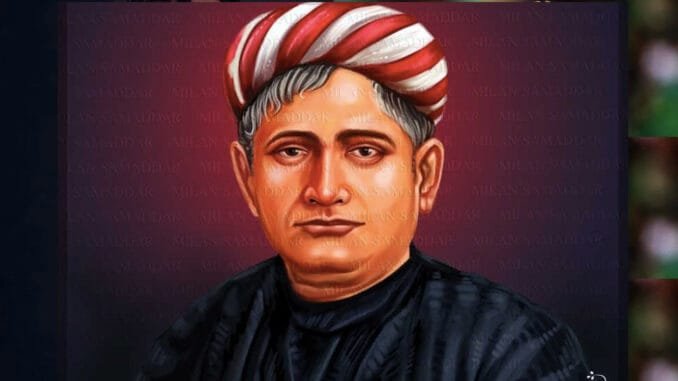
Bankim Chandra Chatterjee biography explores the life of India’s national song composer. Learn about his wife, literary works, Anandamath, and lasting legacy.
Who is Bankim Chandra Chatterjee?
Bankim Chandra Chatterjee biography reveals the extraordinary life of one of India’s most influential literary figures. Born Bankim Chandra Chattopadhyay on 26 June 1838 in Kanthalpara village near Naihati, Bengal, he became the voice of a nation yearning for cultural revival. He passed away on 8 April 1894 at the age of 55, leaving behind a legacy that continues to inspire millions.
Chatterjee holds the distinguished honour of composing Vande Mataram, India’s national song, which first appeared in his celebrated novel Anandamath (1882). The song personified India as a mother goddess and became the rallying cry for freedom fighters during the independence movement. His contribution to Indian literature earned him the title Sahitya Samrat, meaning Emperor of Literature.
As one of the first graduates of the University of Calcutta, Chatterjee balanced a successful career in the British Indian Civil Service with his passion for writing. He served as Deputy Magistrate and Deputy Collector for over three decades whilst producing fourteen Bengali novels and numerous essays that transformed Bengali literature.
Chatterjee is widely regarded as the father of the modern Indian novel. His works established prose as a major literary vehicle for Bengali and created a distinct school of fiction blending European narrative techniques with Indian themes.
Quick Facts Table
| Attribute | Details |
|---|---|
| Full Name | Bankim Chandra Chattopadhyay |
| Date of Birth | 26 June 1838 |
| Place of Birth | Kanthalpara, Naihati, Bengal (now West Bengal) |
| Date of Death | 8 April 1894 |
| Age at Death | 55 years |
| Nationality | Indian (British India) |
| Religion | Hinduism (Brahmin) |
| Father | Yadav Chandra Chattopadhyaya (Deputy Collector) |
| Mother | Durgadebi |
| Brother | Sanjib Chandra Chattopadhyay (novelist) |
| First Wife | Name unknown (married 1849, died 1859/1860) |
| Second Wife | Rajlakshmi Devi |
| Children | Three daughters |
| Profession | Novelist, Poet, Essayist, Journalist, Civil Servant |
| Famous Work | Anandamath (containing Vande Mataram) |
| Title | Sahitya Samrat (Emperor of Literature) |
| Honours | Companion, Order of the Indian Empire (CIE) 1894 |
Early Life and Background
Bankim Chandra Chatterjee was born into an orthodox Brahmin family in the village of Kanthalpara, located in the North 24 Parganas district of Bengal. He was the youngest of three brothers born to Yadav Chandra Chattopadhyaya and Durgadebi. His father served as a government official and later became the Deputy Collector of Midnapur.
The name Bankim Chandra holds poetic significance in Bengali, meaning the crescent moon on the second day of the bright fortnight. His elder brother, Sanjib Chandra Chattopadhyay, also became a novelist. Growing up in a family that valued education, young Bankim developed an early interest in Sanskrit studies.
After his father’s posting to Midnapur, Chatterjee received his early education there. He later studied at Mohsin College in Hooghly for six years. His extensive reading of Sanskrit texts profoundly influenced his later literary style and distinctive Bengali prose.
Educational Background
Chatterjee’s academic journey took him from Mohsin College to the prestigious Presidency College in Calcutta, where he enrolled in 1856. Despite the Indian Rebellion of 1857, he continued his studies and passed his Bachelor of Arts examination in 1857.
He became one of the first two graduates of the University of Calcutta, a significant milestone in Indian higher education. His academic excellence continued when he obtained a law degree from the same university in 1869.
Chatterjee’s education combined Western learning with deep knowledge of Indian classical traditions. This unique blend enabled him to create literature incorporating European narrative structures whilst remaining rooted in Indian culture.
Career Journey
Following his graduation, the Lieutenant Governor of Bengal appointed Chatterjee as Deputy Collector in 1858. He initially served at Jessore before being transferred to various districts. His government career spanned thirty-two years, during which he rose to become Deputy Magistrate and Deputy Collector.
Throughout his administrative career, he often clashed with colonial authorities, reflecting his complex relationship with British rule. Despite serving the government, he harboured deep concerns about the cultural condition of Bengal.
His literary career flourished alongside his official duties. In 1864, his English novel Rajmohan’s Wife appeared serially in the Indian Field. Recognising that English would not reach the masses, he switched to Bengali. Durgeshnandini (1865), his first Bengali romance, captivated readers across Bengal.
In 1872, Chatterjee launched Bangadarshan, a monthly literary magazine that became a platform for Bengali intellectual discourse. The magazine serialised novels alongside essays on religion and social issues.
Literary Timeline
| Year | Work/Milestone | Significance |
|---|---|---|
| 1858 | Lalita O Manas (poetry) | First published work |
| 1864 | Rajmohan’s Wife | First Indian English novel |
| 1865 | Durgeshnandini | First Bengali romantic novel |
| 1866 | Kapalkundala | Established him as major novelist |
| 1872 | Bangadarshan magazine | Literary journalism milestone |
| 1873 | Vishabriksha | Social novel breakthrough |
| 1882 | Anandamath | Contains Vande Mataram |
| 1886 | Krishna Charitra | Philosophical treatise |
| 1891 | Retired from service | After 32 years |
Personal Life and Relationships
Chatterjee’s personal life reflected nineteenth-century Bengali customs. Following prevailing norms, he married at eleven years old. His bride was merely five years old. Tragically, his first wife passed away in 1859 or 1860 when Chatterjee was twenty-two.
After mourning, Chatterjee married Rajlakshmi Devi. The couple had three daughters together. One daughter, Utpala Kumari, tragically died by suicide. Despite personal sorrows, Chatterjee continued his literary pursuits with dedication.
His achievements drew praise from Rabindranath Tagore, who described him as sabyasachi (ambidextrous), noting his ability to create literature whilst guiding aspiring authors. Sri Aurobindo wrote that Chatterjee created a language, a literature, and a nation.
Major Literary Works
Chatterjee’s literary output comprises fourteen Bengali novels, one English novel, and numerous essays and philosophical treatises. His novels fall into three categories: romantic fiction, historical novels, and social novels.
His early works, Durgeshnandini (1865) and Kapalkundala (1866), established the Bengali romantic novel tradition. Kapalkundala, set against Tantric rituals, showcased his atmospheric storytelling. Mrinalini (1869) marked his first historical fiction attempt.
Anandamath (1882) remains his most influential work. Set during the Sannyasi Rebellion against the East India Company, the novel presents India as Bharat Mata (Mother India). The patriotic hymn Vande Mataram first appeared here. The first two stanzas were adopted as India’s National Song in 1950.
Other significant works include Chandrasekhar (1877), Rajsimha (1881), Devi Chaudhurani (1884), and Sitaram (1887). His philosophical works, Dharmatattva (1888) and Krishna Charitra (1886), reveal his engagement with Hindu theology.
Awards and Recognition
The British colonial government awarded Chatterjee the Companion of the Order of the Indian Empire (CIE) in 1894, shortly before his death. This honour acknowledged both his government service and literary achievements.
The Government of West Bengal established the Bankim Puraskar (Bankim Memorial Award) in his honour, recognising outstanding contributions to Bengali fiction. This remains the highest literary honour in West Bengal.
His influence shaped generations of writers and freedom fighters. His work inspired Pramathanath Mitra to establish the Anushilan Samiti revolutionary organisation. Vande Mataram became synonymous with Indian nationalism.
Final Thoughts
Bankim Chandra Chatterjee’s legacy transcends literature to encompass nation-building. His works awakened Bengali consciousness during colonial subjugation, instilling pride in Indian culture and history. The themes of patriotism and cultural identity in his writing continue to resonate with readers.
His portrayal of strong female characters was revolutionary for nineteenth-century literature. Novels like Devi Chaudhurani explored female empowerment decades before such ideas became mainstream.
Chatterjee died on 8 April 1894 in Calcutta, suffering from diabetes. His writings lived on to fuel the independence movement. Rabindranath Tagore revived his magazine Bangadarshan in 1901. Today, Bankim Chandra Chatterjee is remembered as the literary architect who gave India its voice of freedom through the immortal words of Vande Mataram.
FAQs About Bankim Chandra Chatterjee
Who wrote Vande Mataram, India’s national song?
Bankim Chandra Chatterjee composed Vande Mataram in Sanskritised Bengali. The song appeared in his 1882 novel Anandamath and was adopted as India’s National Song in 1950.
When was Bankim Chandra Chatterjee born and when did he die?
Chatterjee was born on 26 June 1838 in Kanthalpara village near Naihati, Bengal. He died on 8 April 1894 in Calcutta at the age of 55.
What is Bankim Chandra Chatterjee’s most famous novel?
Anandamath (1882) is his most famous novel. It contains Vande Mataram and depicts the Sannyasi Rebellion, inspiring generations of freedom fighters.
Who was Bankim Chandra Chatterjee’s wife?
Chatterjee married twice. His first wife died when he was twenty-two. He then married Rajlakshmi Devi, with whom he had three daughters.
Why is Bankim Chandra Chatterjee called Sahitya Samrat?
He earned the title Sahitya Samrat (Emperor of Literature) for his extraordinary contributions to Bengali literature as the father of the modern Indian novel.
What was Bankim Chandra Chatterjee’s profession?
Besides writing, Chatterjee served as Deputy Magistrate and Deputy Collector in the British Indian Civil Service for thirty-two years, retiring in 1891.
Leave a Reply