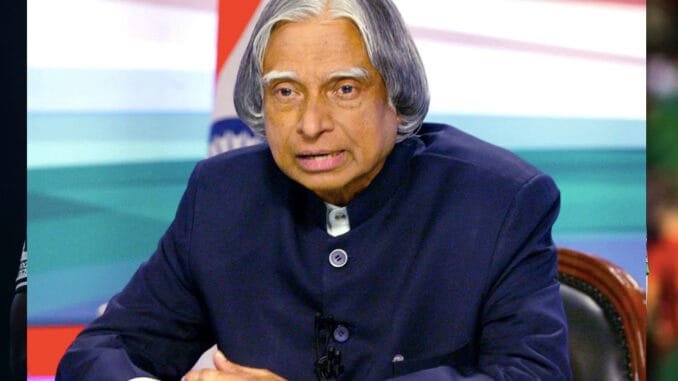
A. P. J. Abdul Kalam biography explores India’s Missile Man and 11th President. Discover his age, family, books like Wings of Fire, and Bharat Ratna legacy.
Who is A. P. J. Abdul Kalam?
A. P. J. Abdul Kalam biography tells the extraordinary story of India’s most beloved scientist and statesman. Born Avul Pakir Jainulabdeen Abdul Kalam on 15 October 1931 in Rameswaram, Tamil Nadu, he rose from humble beginnings to become the 11th President of India, serving from 2002 to 2007. Known as the “Missile Man of India” and the “People’s President,” Kalam passed away on 27 July 2015 at the age of 83.
Kalam’s journey represents one of modern India’s most inspiring success stories. Born into a poor Tamil Muslim family, he sold newspapers as a child to support his family. Through determination, he transformed into one of the world’s most respected aerospace scientists who shaped India’s defence and space programmes.
Throughout his four-decade career, Kalam worked at the Defence Research and Development Organisation (DRDO) and Indian Space Research Organisation (ISRO). He played pivotal roles in developing India’s first satellite launch vehicle and the country’s ballistic missile programme.
Beyond scientific achievements, Kalam dedicated his life to inspiring India’s youth, believing young people held the key to transforming India into a developed nation.
Quick Facts Table
| Attribute | Details |
|---|---|
| Full Name | Avul Pakir Jainulabdeen Abdul Kalam |
| Date of Birth | 15 October 1931 |
| Date of Death | 27 July 2015 |
| Age at Death | 83 years old |
| Place of Birth | Rameswaram, Tamil Nadu, India |
| Religion | Islam |
| Nationality | Indian |
| Father | Jainulabdeen Marakayar (boat owner, imam) |
| Mother | Ashiamma (housewife) |
| Siblings | Four brothers, one sister |
| Marital Status | Lifelong bachelor |
| Education | St. Joseph’s College; Madras Institute of Technology |
| Profession | Aerospace Scientist, Statesman, Author |
| Position Held | 11th President of India (2002-2007) |
| Nicknames | Missile Man of India, People’s President |
| Highest Award | Bharat Ratna (1997) |
Early Life and Background
A. P. J. Abdul Kalam was born into a Tamil Muslim family in the pilgrimage town of Rameswaram on Pamban Island. His father, Jainulabdeen Marakayar, was a boat owner who ferried Hindu pilgrims and also served as the imam of the local mosque. His mother, Ashiamma, was a devoted housewife.
Kalam was the youngest of five siblings. Despite modest circumstances, his parents ensured their children received proper nourishment and education. To supplement the family income, young Kalam sold newspapers during his school years.
Growing up in Rameswaram shaped Kalam’s character profoundly. He witnessed remarkable religious harmony between Hindus and Muslims, deeply influencing his secular outlook and belief in India’s unity amidst diversity.
Educational Background
Kalam began his education at Schwartz Higher Secondary School in Ramanathapuram after completing elementary schooling in Rameswaram. Teachers recognised his strong desire to learn, particularly his fascination with mathematics and science.
In 1954, Kalam graduated with a degree in physics from St. Joseph’s College, Tiruchirappalli. His passion for aerospace led him to the Madras Institute of Technology (MIT), where he completed his aeronautical engineering degree in 1960.
During his time at MIT, Kalam nearly became a fighter pilot. He appeared for the Indian Air Force selection but secured the ninth position when only eight candidates were needed. This setback redirected his path towards scientific research, ultimately proving more consequential for India’s development.
Career Journey
Kalam joined the Aeronautical Development Establishment of the DRDO as a senior scientific assistant in 1958. In 1963, he visited NASA’s facilities in the United States, an experience that shaped his vision for Indian space research.
In 1969, Kalam transferred to ISRO, where he led the development of India’s first indigenous Satellite Launch Vehicle (SLV-III). On 18 July 1980, the SLV-III successfully placed the Rohini satellite into orbit.
Returning to DRDO in 1982, Kalam headed the Integrated Guided Missile Development Programme. Under his leadership, India developed five strategic missiles: Prithvi, Agni, Trishul, Akash, and Nag, earning him the title “Missile Man of India.”
He played a crucial role in the Pokhran-II nuclear tests in May 1998. In 2002, he was elected the 11th President of India, becoming the first scientist and bachelor to occupy Rashtrapati Bhavan.
Career Timeline
| Year | Milestone | Significance |
|---|---|---|
| 1958 | Joined DRDO | Began scientific career |
| 1969 | Transferred to ISRO | Led SLV project |
| 1980 | SLV-III success | India’s first satellite launch |
| 1982 | Director, IGMDP | Led missile programme |
| 1998 | Pokhran-II tests | India becomes nuclear power |
| 2002 | Elected President | 11th President of India |
| 2015 | Passed away | Died at IIM Shillong |
Personal Life
Unlike most public figures, A. P. J. Abdul Kalam remained a lifelong bachelor. He devoted his entire life to science, education, and national service. He maintained close relationships with his siblings and their families, regularly sending them financial support despite his modest lifestyle.
Kalam was known for his simplicity and humility. Even as President, he maintained an austere lifestyle. His personal interests included playing the veena, a traditional Indian string instrument, and writing Tamil poetry.
His spiritual inclinations drew from multiple traditions. Though born Muslim, Kalam studied the Bhagavad Gita alongside Islamic texts. He believed in the unity of all religions, reflecting the communal harmony he witnessed growing up in Rameswaram.
Books and Literary Contributions
Kalam authored numerous books that continue to inspire millions worldwide. His autobiography, “Wings of Fire” (1999), co-written with Arun Tiwari, became a bestseller translated into thirteen languages, chronicling his journey from poverty to becoming India’s foremost scientist.
“India 2020” (1998), co-authored with Y. S. Rajan, outlined his plan for transforming India into a developed nation. “Ignited Minds” (2002) encouraged young readers to dream big. Other works include “Turning Points” (2012) and “Transcendence” (2015). These books sold millions of copies and established Kalam as one of India’s most influential authors.
Major Achievements and Awards
Kalam received India’s three highest civilian honours: Padma Bhushan (1981), Padma Vibhushan (1990), and Bharat Ratna (1997). He was only the third President to receive the Bharat Ratna before assuming office.
His scientific achievements transformed India’s capabilities in space and defence technology. The successful development of the SLV-III and missiles like Agni and Prithvi established India among world leaders in these fields.
Kalam received honorary doctorates from over forty universities. Several places bear his name, including Abdul Kalam Island and Mount Kalam. His birthday, 15 October, is celebrated globally as World Students’ Day.
Death and Legacy
On 27 July 2015, Kalam travelled to Shillong to deliver a lecture at the Indian Institute of Management. Five minutes into his presentation, he collapsed due to cardiac arrest and was declared dead at 7:45 PM.
The Government of India declared seven days of state mourning. His funeral in Rameswaram was attended by thousands. He was laid to rest with full state honours near his ancestral home.
The Dr. A. P. J. Abdul Kalam Memorial in Rameswaram, inaugurated by Prime Minister Modi in 2017, honours his memory. His legacy endures through the countless students he inspired and his vision for a developed India.
Final Thoughts
A. P. J. Abdul Kalam’s life demonstrates the transformative power of education, determination, and service. From selling newspapers as a child to leading India’s space and missile programmes, his journey embodies the possibilities available to those who dream big.
His vision for India extended beyond technological achievement to encompass moral and spiritual development. This philosophy resonated deeply with ordinary Indians who saw in him a leader of genuine integrity.
Kalam’s greatest legacy remains the millions of young Indians he inspired to pursue careers in science and technology. As India advances towards developed nation status, the “People’s President” remains a guiding light for the country’s aspirations.
FAQs About A. P. J. Abdul Kalam
When was A. P. J. Abdul Kalam born and when did he die?
A. P. J. Abdul Kalam was born on 15 October 1931 in Rameswaram, Tamil Nadu. He passed away on 27 July 2015 at age 83 while lecturing at IIM Shillong.
Why is A. P. J. Abdul Kalam called the Missile Man of India?
Kalam earned this title for leading the Integrated Guided Missile Development Programme, which developed five strategic missiles: Prithvi, Agni, Trishul, Akash, and Nag.
Was A. P. J. Abdul Kalam married?
No, A. P. J. Abdul Kalam remained a lifelong bachelor, dedicating his entire life to science, education, and national service.
What awards did A. P. J. Abdul Kalam receive?
Kalam received India’s three highest civilian honours: Padma Bhushan (1981), Padma Vibhushan (1990), and Bharat Ratna (1997).
What books did A. P. J. Abdul Kalam write?
His notable books include “Wings of Fire” (autobiography), “India 2020,” “Ignited Minds,” and “Turning Points.”
Which position did A. P. J. Abdul Kalam hold?
Kalam served as the 11th President of India from 2002 to 2007, becoming the first scientist and first bachelor to hold this position.
Leave a Reply